
What is Machine Learning?
Machine learning is a branch of artificial intelligence (AI) that focuses on developing algorithms that allow computers to learn from data. Unlike traditional programming, where a developer writes explicit rules for every possible input and output, machine learning systems learn to identify patterns and make predictions or decisions based on observed data. This capability to learn and adapt without being explicitly programmed is what makes ML so powerful and transformative.
At its core, machine learning involves building mathematical models from sample data, known as "training data," in order to make predictions or decisions without being explicitly programmed to perform the task. The goal is for the machine to generalize from the training data to unseen data, meaning it can perform well on new, never-before-seen examples.
This field is distinct from, yet intimately related to, broader AI. While AI encompasses any technique that enables computers to mimic human intelligence, ML is a specific approach to achieving that intelligence through learning from data. For a deeper dive into the relationship between these fields, consider reading our article on "Artificial Intelligence vs Machine Learning: What's the Difference?".
The Fundamental Paradigms of Machine Learning
Machine learning is broadly categorized into several paradigms, each suited for different types of problems and data. Understanding these distinctions is crucial for selecting the right approach for a given task.
1. Supervised Learning
Supervised learning is the most common ML paradigm. In this approach, the model learns from a labeled dataset, meaning each piece of training data comes with a corresponding correct output. The model's task is to learn a mapping function from inputs to outputs, so it can accurately predict the output for new, unseen inputs.
- Classification: Predicts a categorical label (e.g., spam/not spam, disease/no disease). Examples include image recognition, sentiment analysis, and medical diagnosis.
- Regression: Predicts a continuous numerical value (e.g., house prices, stock prices, temperature). Examples include predicting housing market trends or forecasting sales.
2. Unsupervised Learning
Unsupervised learning deals with unlabeled data. The goal here is to find hidden patterns, structures, or relationships within the data without any prior knowledge of the output. It's often used for exploratory data analysis, dimensionality reduction, and anomaly detection.
- Clustering: Groups similar data points together. Common algorithms include K-Means and Hierarchical Clustering. Applications include market segmentation and document clustering.
- Dimensionality Reduction: Reduces the number of features (variables) in a dataset while retaining most of the important information. Principal Component Analysis (PCA) is a popular technique, used for data visualization and improving model performance.
- Association Rule Mining: Discovers interesting relationships between variables in large databases (e.g., "people who buy X also tend to buy Y"). Often used in recommendation systems.
3. Reinforcement Learning
Reinforcement learning (RL) involves an agent learning to make decisions by interacting with an environment. The agent receives rewards for desirable actions and penalties for undesirable ones, learning through trial and error to maximize its cumulative reward. This paradigm is particularly effective for problems where sequential decision-making is critical.
- Key Components: Agent, Environment, States, Actions, Rewards, Policy.
- Applications: Robotics, game playing (e.g., AlphaGo), autonomous navigation, resource management.
4. Semi-Supervised Learning
This paradigm combines elements of both supervised and unsupervised learning. It uses a small amount of labeled data along with a large amount of unlabeled data during training. This can be particularly useful when labeling data is expensive or time-consuming.
5. Self-Supervised Learning
Self-supervised learning is a newer paradigm where the system generates its own labels from the input data. It's often used to pre-train large models, especially in natural language processing and computer vision, by solving a 'pretext task' (e.g., predicting missing words in a sentence) and then fine-tuning the learned representations for downstream tasks.
Key Machine Learning Algorithms
The power of machine learning lies in its diverse array of algorithms, each with its strengths and weaknesses. Here's a look at some of the most fundamental and widely used ones:
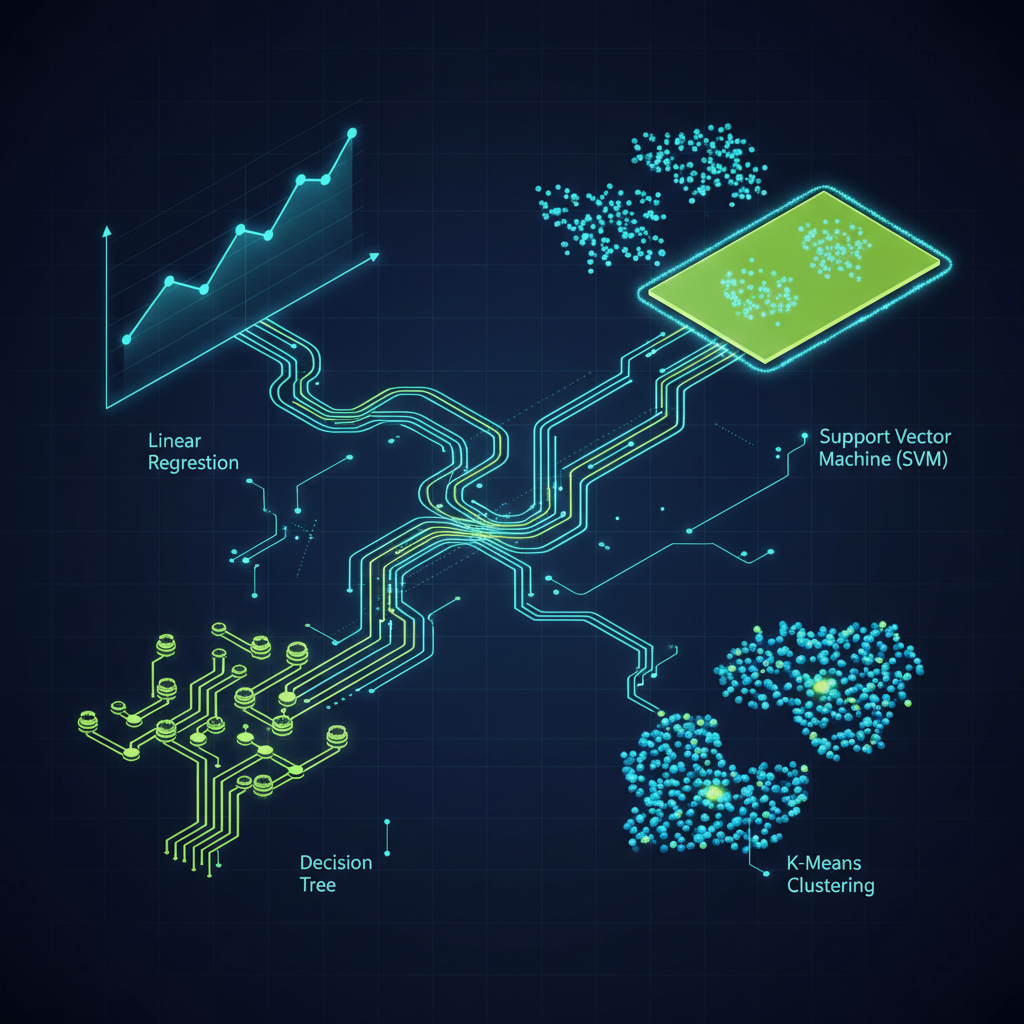
Supervised Learning Algorithms
- Linear Regression: A simple algorithm for predicting a continuous output based on a linear relationship between input features and the output variable. It finds the best-fitting straight line through the data points.
- Logistic Regression: Despite its name, it's a classification algorithm used for predicting a binary outcome (0 or 1). It uses a logistic function to model the probability of a certain class.
- Decision Trees: A flowchart-like structure where each internal node represents a test on an attribute, each branch represents the outcome of the test, and each leaf node represents a class label or a numerical value. They are intuitive and easy to interpret.
- Support Vector Machines (SVMs): A powerful algorithm for classification and regression. SVMs find the optimal hyperplane that best separates data points into different classes, maximizing the margin between them.
- K-Nearest Neighbors (KNN): A non-parametric, instance-based learning algorithm. For classification, it classifies a data point based on the majority class of its 'k' nearest neighbors. For regression, it predicts the average of its 'k' nearest neighbors.
- Random Forests: An ensemble learning method that constructs a multitude of decision trees during training and outputs the mode of the classes (for classification) or mean prediction (for regression) of the individual trees. This reduces overfitting and improves accuracy.
- Gradient Boosting (e.g., XGBoost, LightGBM): Another powerful ensemble technique that builds trees sequentially, with each new tree correcting the errors of the previous ones. Highly effective in many real-world applications.
Unsupervised Learning Algorithms
- K-Means Clustering: An iterative algorithm that partitions 'n' observations into 'k' clusters, where each observation belongs to the cluster with the nearest mean (centroid).
- Hierarchical Clustering: Builds a hierarchy of clusters. It can be agglomerative (bottom-up) or divisive (top-down).
- Principal Component Analysis (PCA): A dimensionality reduction technique that transforms a large set of variables into a smaller one that still contains most of the information. It identifies the principal components, which are orthogonal (uncorrelated) linear combinations of the original variables.
Neural Networks and Deep Learning
While often considered a separate field, deep learning is a subfield of machine learning that uses artificial neural networks with multiple layers (hence "deep"). These networks are particularly good at learning complex patterns from large amounts of data, especially in areas like image and speech recognition.
- Artificial Neural Networks (ANNs): Inspired by the human brain, ANNs consist of interconnected nodes (neurons) organized in layers. They learn by adjusting the weights of connections between neurons.
- Convolutional Neural Networks (CNNs): Specialized for processing grid-like data, such as images. They use convolutional layers to automatically and adaptively learn spatial hierarchies of features.
- Recurrent Neural Networks (RNNs): Designed for sequential data, like time series or natural language. They have internal memory that allows them to process sequences of inputs.
- Transformers: A more recent architecture, particularly dominant in natural language processing, known for its ability to handle long-range dependencies in sequential data through self-attention mechanisms. ChatGPT for Beginners and What is Prompt Engineering? discuss applications of these advanced models.
For a more detailed exploration of these advanced concepts, refer to our "Deep Learning: A Practical Guide To Neural Networks" article.
The Machine Learning Workflow
Building an effective machine learning system involves a structured process, often iterative. Understanding this workflow is crucial for anyone looking to implement ML solutions.
- Problem Definition: Clearly define the objective. What problem are you trying to solve? What kind of output is expected? Is it classification, regression, clustering, etc.?
- Data Collection: Gather relevant data. The quality and quantity of data significantly impact model performance. This step often involves sourcing data from databases, APIs, or external sources.
- Data Preprocessing: This is often the most time-consuming step. It includes:
- Cleaning: Handling missing values, correcting errors, removing duplicates.
- Transformation: Scaling, normalization, encoding categorical variables.
- Feature Engineering: Creating new features from existing ones to improve model performance. This requires domain expertise and creativity.
- Splitting: Dividing data into training, validation, and test sets.
- Model Selection: Choose an appropriate algorithm based on the problem type, data characteristics, and computational resources. This often involves experimenting with several algorithms.
- Model Training: Feed the preprocessed training data to the selected algorithm. The model learns patterns and relationships from this data.
- Model Evaluation: Assess the model's performance on unseen data (validation/test sets) using appropriate metrics (accuracy, precision, recall, F1-score, RMSE, R-squared, etc.). This step helps identify if the model is overfitting or underfitting.
- Hyperparameter Tuning: Adjust the model's hyperparameters (settings that are not learned from data but set before training) to optimize performance. This can be done manually or using techniques like grid search or random search.
- Deployment: Integrate the trained and optimized model into a production environment where it can make predictions on new, real-world data.
- Monitoring and Maintenance: Continuously monitor the model's performance in production. Data drift, concept drift, or changes in the environment can degrade performance over time, requiring retraining or updating the model.
"Data is the new oil." This adage, while often debated, underscores the critical role of data in machine learning. Without quality data, even the most sophisticated algorithms will fail to deliver meaningful results.

Tools and Technologies for Machine Learning
The machine learning ecosystem is vast and constantly evolving, offering a wide array of tools for every stage of the workflow.
Programming Languages
- Python: Dominant in ML due to its extensive libraries (NumPy, Pandas, Scikit-learn, TensorFlow, PyTorch), ease of use, and large community. Our article "Python For Beginners: The Language That Will Get You Hired" is a great starting point.
- R: Popular in academia and statistics, with strong capabilities for statistical modeling and data visualization.
- Julia: A newer language gaining traction for its speed and suitability for numerical and scientific computing.
Core Libraries and Frameworks
- Scikit-learn: A comprehensive library for traditional machine learning algorithms (classification, regression, clustering, dimensionality reduction) in Python.
- TensorFlow: An open-source end-to-end platform for machine learning developed by Google. Widely used for deep learning.
- PyTorch: Another open-source machine learning framework, primarily developed by Facebook's AI Research lab (FAIR). Known for its flexibility and ease of use, especially in research.
- Keras: A high-level neural networks API, written in Python and capable of running on top of TensorFlow, CNTK, or Theano. It's designed for fast experimentation.
Data Handling and Visualization
- Pandas: A Python library for data manipulation and analysis, offering data structures like DataFrames.
- NumPy: The fundamental package for numerical computing with Python, providing support for large, multi-dimensional arrays and matrices.
- Matplotlib & Seaborn: Python libraries for creating static, interactive, and animated visualizations.
Cloud Platforms
Cloud providers offer managed services for ML development, training, and deployment, abstracting away much of the infrastructure complexity. "AWS vs Azure vs Google Cloud: A Grown-Up Comparison" explores the leading options.
- AWS SageMaker: Amazon's fully managed service that provides every developer and data scientist with the ability to build, train, and deploy machine learning models quickly.
- Google Cloud AI Platform: Google's suite of services for building and deploying ML models, leveraging their expertise in AI.
- Azure Machine Learning: Microsoft's cloud-based platform for training, deploying, and managing ML models.
Challenges and Ethical Considerations in Machine Learning
As machine learning systems become more sophisticated and integrated into critical applications, several challenges and ethical considerations come to the forefront.
Data Quality and Bias
- "Garbage In, Garbage Out": The performance of ML models is highly dependent on the quality of the training data. Biased, incomplete, or noisy data will lead to biased and inaccurate models.
- Algorithmic Bias: If training data reflects societal biases (e.g., historical discrimination), the model will learn and perpetuate these biases, leading to unfair or discriminatory outcomes in areas like hiring, loan applications, or criminal justice. Addressing this requires careful data curation and bias detection techniques.
Interpretability and Explainability (XAI)
- Black Box Models: Complex models, especially deep neural networks, can be difficult to understand. It's often hard to explain why a model made a particular prediction, which is problematic in high-stakes domains like healthcare or finance.
- Need for XAI: Explainable AI (XAI) is a field dedicated to developing methods that make ML models more transparent and understandable, allowing humans to comprehend, trust, and effectively manage AI systems.
Privacy and Security
- Data Privacy: Training models often requires vast amounts of personal data, raising concerns about privacy. Techniques like differential privacy and federated learning are being developed to mitigate these risks.
- Adversarial Attacks: ML models can be vulnerable to malicious inputs designed to trick them into making incorrect predictions. This is a significant concern for critical applications like autonomous vehicles.
Accountability and Control
- Who is Responsible?: When an autonomous ML system makes an error or causes harm, determining accountability can be complex. Establishing clear frameworks for responsibility is crucial.
- Human Oversight: The debate continues on the appropriate level of human oversight for autonomous ML systems, balancing efficiency with safety and ethical considerations.
Environmental Impact
- Computational Cost: Training large-scale deep learning models can require significant computational resources, leading to substantial energy consumption and carbon footprints. This is an emerging ethical and practical concern.
Machine Learning vs. Deep Learning vs. Data Science
These terms are often used interchangeably, but they represent distinct, albeit overlapping, fields.
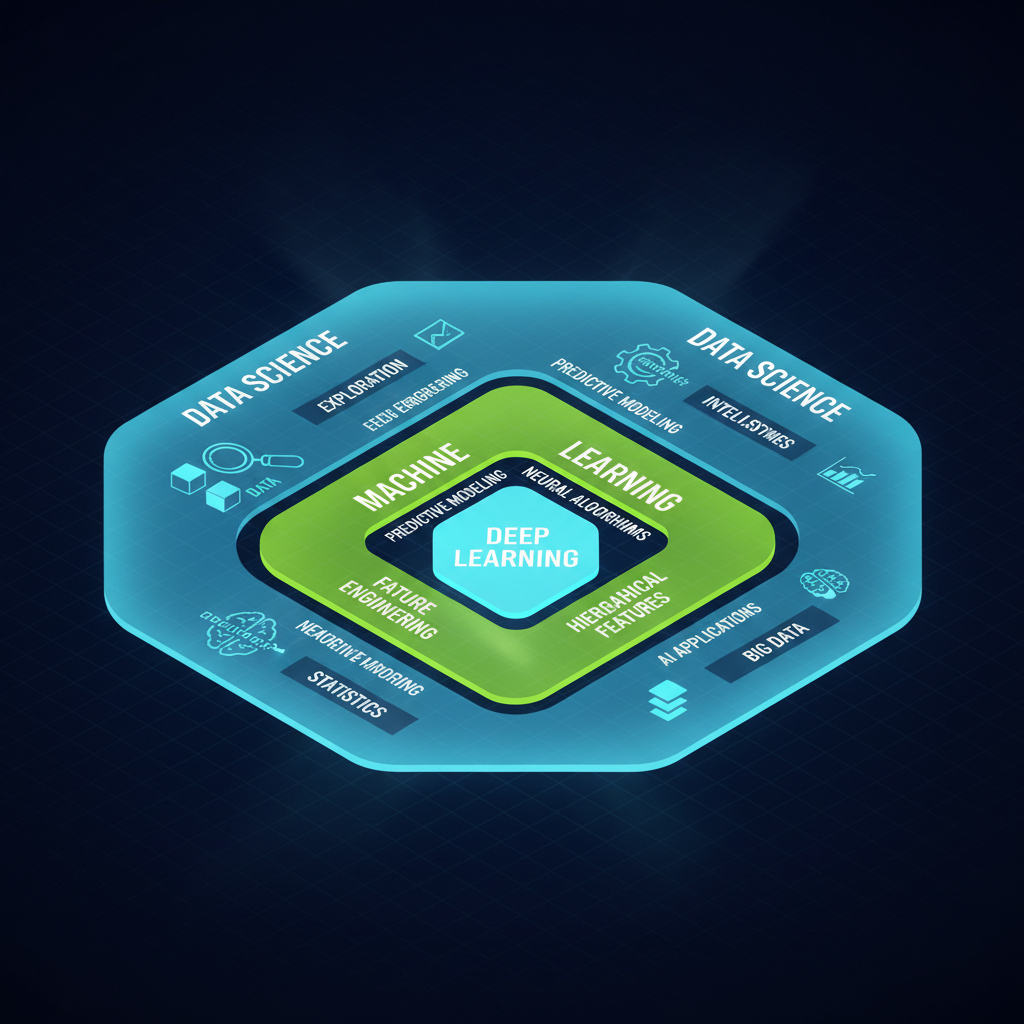
| Feature | Machine Learning | Deep Learning | Data Science |
|---|---|---|---|
| Scope | Subset of AI; enables systems to learn from data. | Subset of ML; uses neural networks with many layers. | Interdisciplinary field for extracting knowledge from data. |
| Methodology | Algorithms like linear regression, SVMs, decision trees. | Multi-layered neural networks (CNNs, RNNs, Transformers). | Statistics, programming, domain expertise, ML, visualization. |
| Data Type Focus | Structured and unstructured data. | Highly effective with unstructured data (images, text, audio). | All data types. |
| Data Volume | Can work with moderate to large datasets. | Requires very large datasets to perform optimally. | Can work with any data volume. |
| Complexity | Varies from simple to complex. | Generally more computationally intensive and complex. | Encompasses the entire data lifecycle. |
| Key Skills | Math, statistics, programming, algorithm selection. | Advanced math, neural network architectures, GPU programming. | Statistics, programming, ML, domain knowledge, communication, data visualization. |
| Typical Role | Machine Learning Engineer, Data Scientist. | Deep Learning Engineer, AI Researcher. | Data Scientist, Data Analyst, Machine Learning Engineer. |
For more context, explore "Thinking Clearly About Data Science" and "How Machine Learning Systems Are Actually Built".
The Future of Machine Learning
The field of machine learning is dynamic and continuously evolving. Several trends are shaping its future:
- Automated Machine Learning (AutoML): Tools that automate parts of the ML workflow, from data preprocessing to model selection and hyperparameter tuning, making ML more accessible.
- Reinforcement Learning Advancements: Continued breakthroughs in RL are expected, particularly in robotics, autonomous systems, and complex decision-making environments.
- Ethical AI and Responsible ML: Increasing focus on developing fair, transparent, and accountable AI systems, addressing bias, privacy, and interpretability concerns.
- Edge AI: Deploying ML models directly on edge devices (e.g., smartphones, IoT devices) to enable real-time processing, reduce latency, and enhance privacy.
- Foundation Models and Generative AI: Large pre-trained models (like GPT-3, DALL-E) that can be adapted to a wide range of tasks are transforming areas like content creation, drug discovery, and scientific research. This ties into topics like "What is Prompt Engineering?" and "ChatGPT vs Claude vs Gemini".
- Interdisciplinary Applications: ML will continue to integrate with other fields like quantum computing, neuroscience, and materials science, opening up new frontiers.
Getting Started with Machine Learning
If you're inspired to delve deeper into machine learning, here's a roadmap to begin your journey:
- Master the Fundamentals: Build a strong foundation in linear algebra, calculus, probability, and statistics. These are the mathematical pillars of ML.
- Learn Python: It's the lingua franca of ML. Familiarize yourself with its syntax and core libraries (NumPy, Pandas).
- Understand Core ML Concepts: Start with supervised learning (regression, classification), then move to unsupervised learning and reinforcement learning.
- Practice with Scikit-learn: It's an excellent library for implementing traditional ML algorithms and understanding the workflow.
- Explore Deep Learning: Once comfortable with traditional ML, dive into TensorFlow or PyTorch to build neural networks.
- Work on Projects: Apply your knowledge to real-world datasets. Kaggle is a great platform for this.
- Stay Updated: The field evolves rapidly. Follow research papers, blogs, and online communities.
For a structured learning path, consider our "Data Science Roadmap: From Curious Beginner To Employable Data Scientist" or "How To Become A Data Scientist: The Career Path Explained".