

Quick Summary
Artificial Intelligence (AI) is the science of building machines that can perceive, reason, learn, and act — often at a scale and speed that humans cannot match. In 2026, AI is no longer a research topic; it is embedded in your phone, your bank, your hospital, your classroom, and your career.
This complete beginner's guide breaks down what AI actually is, how it works under the hood, the different types you'll hear about (Narrow AI, General AI, Machine Learning, Deep Learning, Generative AI, LLMs), where it's used in the real world, and — most importantly — how you can build an AI-powered career in 2026 and beyond, even if you're starting from zero.
You don't need a PhD to work in AI. You need curiosity, a structured roadmap, and the right stack of practical skills. This guide gives you all three.
Key Takeaways
- AI is a family of technologies, not a single product. It includes Machine Learning, Deep Learning, Generative AI, LLMs, computer vision, robotics, and more.
- Machine Learning is a subset of AI, and Deep Learning is a subset of Machine Learning. They are nested, not competing.
- Generative AI (ChatGPT, Claude, Gemini, Midjourney) is the fastest-growing branch — it creates content instead of just classifying it.
- AI is already deployed at scale in healthcare diagnostics, fraud detection, adaptive learning, autonomous vehicles, and content creation.
- AI careers are exploding. Roles like AI Engineer, ML Engineer, Prompt Engineer, Data Scientist, and AI Product Manager routinely pay 2–4× traditional tech salaries.
- You can start today. A structured 6–12 month roadmap — Python → ML → Deep Learning → LLMs → Portfolio — is enough to land your first AI role.
Table of Contents
- Introduction: Why AI Matters in 2026
- A Short History of AI
- How AI Actually Works
- The Types of AI
- Machine Learning Explained
- Deep Learning Explained
- Generative AI
- Large Language Models (LLMs)
- Real-World Applications
- AI in Healthcare
- AI in Finance
- AI in Education
- AI in Manufacturing
- AI Career Opportunities
- Required Skills
- Learning Roadmap
- The Future of AI
- Frequently Asked Questions
- Final Summary
1. Introduction: Why AI Matters in 2026
Every generation gets one general-purpose technology that redefines work, business, and daily life. Electricity did it. The internet did it. Mobile did it. In 2026, that technology is Artificial Intelligence.
Consider this: the average professional today interacts with AI dozens of times a day without realizing it — Gmail's smart reply, YouTube's recommendations, Google Maps' ETAs, banking fraud alerts, medical scans, code auto-complete, customer support chatbots, and of course, ChatGPT and Claude. According to McKinsey, generative AI alone could add $2.6 to $4.4 trillion to the global economy every year.
But here's what most beginners get wrong: AI is not magic and it is not one thing. It is a stack of concrete techniques — statistics, probability, pattern recognition, and optimization — running on very fast computers with very large datasets. Once you understand the layers, AI stops feeling intimidating and starts feeling like a set of tools you can pick up.
This guide is designed for three audiences:
- Students exploring careers and wondering if AI is the right bet.
- Working professionals who want to future-proof their role or transition into an AI-first career.
- Career switchers from non-technical backgrounds who want a realistic starting point.
By the end, you'll know exactly what AI is, how it works, where it's used, and — with a clear roadmap — how to build a career in it.
2. A Short History of AI
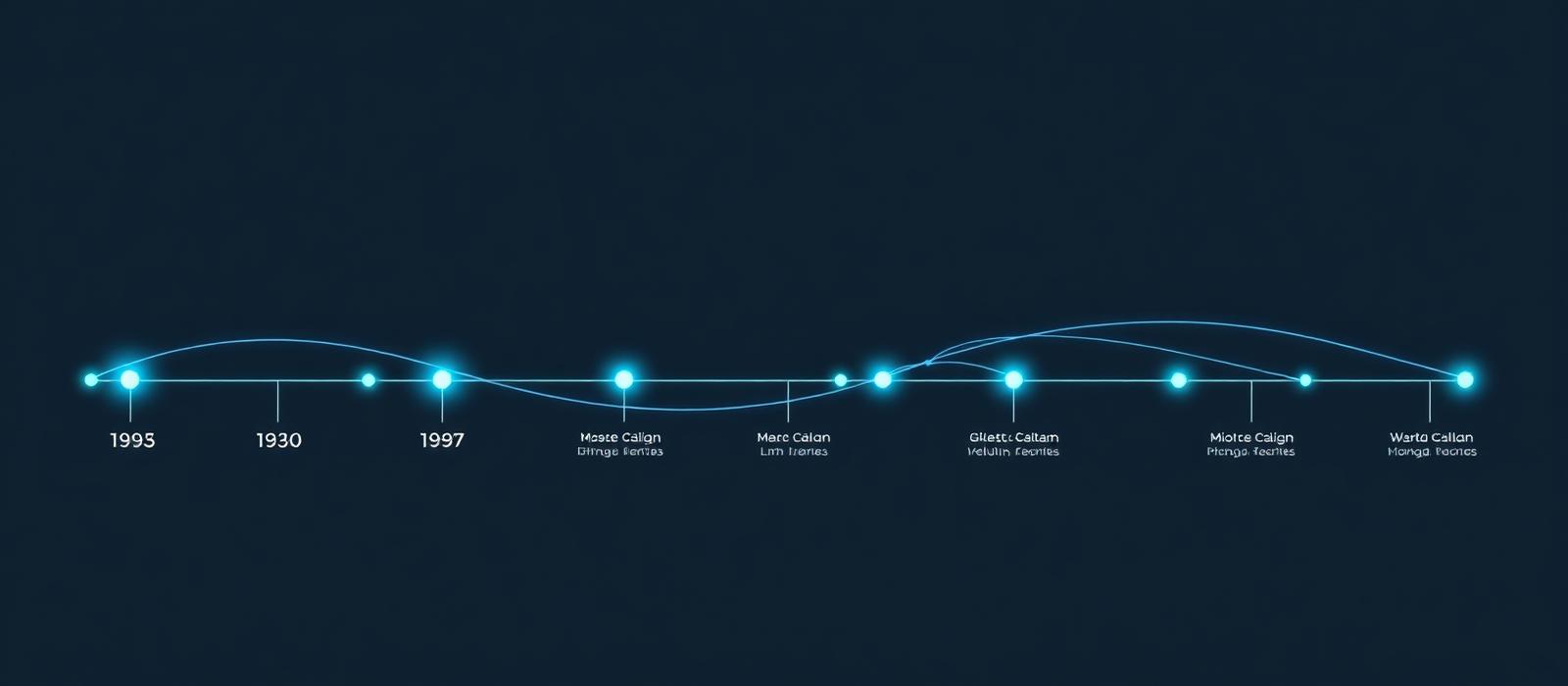
AI feels new, but the field is over 70 years old. Every "sudden" breakthrough you see today stands on decades of research.
| Era | Years | What Happened |
|---|---|---|
| The Origin | 1950–1956 | Alan Turing publishes Computing Machinery and Intelligence. The term "Artificial Intelligence" is coined at the Dartmouth Conference in 1956. |
| The Golden Years | 1956–1974 | Early symbolic AI, expert systems, first chatbots (ELIZA). Optimism runs high. |
| First AI Winter | 1974–1980 | Funding dries up. Computers aren't powerful enough. |
| Expert Systems Boom | 1980–1987 | Rule-based AI powers businesses. Japan's Fifth Generation project launches. |
| Second AI Winter | 1987–1993 | Expert systems collapse under maintenance costs. |
| Statistical Revolution | 1993–2011 | Machine Learning takes over. IBM's Deep Blue beats Kasparov (1997). |
| Deep Learning Era | 2012–2019 | AlexNet wins ImageNet (2012). GPUs power neural networks. Google, Facebook, Microsoft go all-in. |
| The Generative Era | 2020–Present | GPT-3 (2020), ChatGPT (2022), GPT-4, Claude, Gemini, and open-source LLMs redefine what "AI" means to the public. |
The key lesson: AI progresses in waves. What matters is not any single breakthrough — it's the compounding of better algorithms, more data, and faster hardware. That compounding is now accelerating.
3. How AI Actually Works
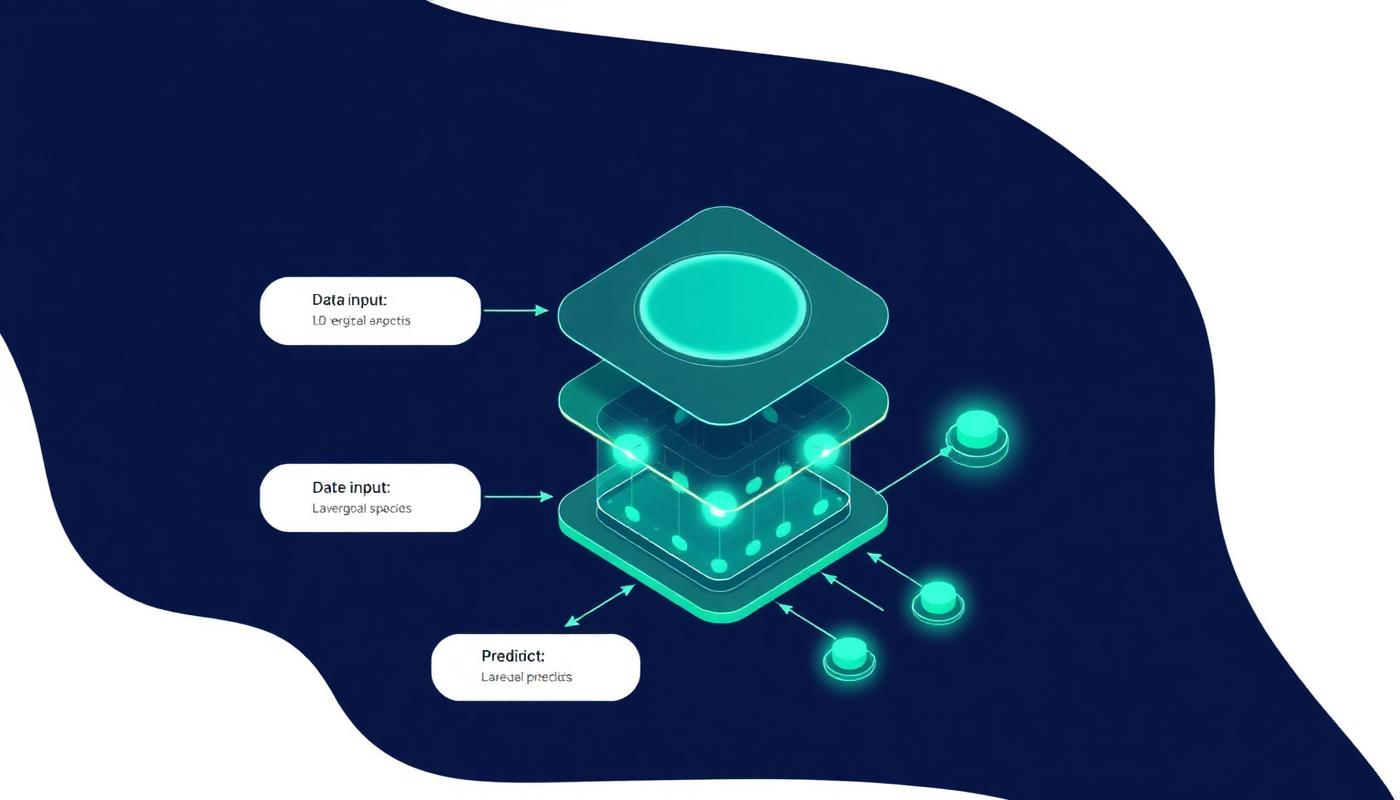
Strip away the buzzwords and every AI system is doing one of two things: classifying (is this email spam or not?) or generating (write me an email). It gets there through a repeatable pipeline:
- Data Collection. Everything starts with data — images, text, transactions, sensor readings.
- Data Preparation. Cleaning, labeling, and structuring so an algorithm can consume it.
- Model Selection. Choosing an algorithm — linear regression, decision tree, neural network, transformer.
- Training. The model looks at millions of examples and adjusts its internal parameters ("weights") to minimize error.
- Evaluation. Testing on data the model has never seen, to check if it generalizes.
- Deployment. Wrapping the model behind an API so an app can call it.
- Monitoring & Retraining. The world changes; models drift; you retrain.
Callout — The "Learning" in Machine Learning: A model doesn't "understand" like a human. It finds statistical patterns. When ChatGPT writes an essay, it is predicting the most likely next token, one token at a time, based on patterns from trillions of tokens of training data. That's it. The magic is in the scale.
4. The Types of AI
AI is usually classified two ways: by capability and by functionality.
By Capability
| Type | Description | Status in 2026 |
|---|---|---|
| Narrow AI (ANI) | Excellent at one specific task (chess, translation, image recognition). | ✅ Everywhere today. |
| General AI (AGI) | Human-level intelligence across all tasks. | ⏳ Actively researched. Not achieved. |
| Super AI (ASI) | Exceeds human intelligence in every domain. | 🔮 Theoretical. |
By Functionality
- Reactive Machines — no memory (Deep Blue). React to the current situation only.
- Limited Memory — can use recent past (self-driving cars). This is where most modern AI lives.
- Theory of Mind — understands emotions and intent. Early research stage.
- Self-Aware AI — conscious of its own state. Purely theoretical.
In practice, when people say "AI" in 2026, they almost always mean Narrow AI with Limited Memory — specialized systems trained on huge datasets.
5. Machine Learning Explained
Machine Learning (ML) is the branch of AI where systems learn from data instead of being explicitly programmed. Instead of writing "if email contains the word 'lottery', mark as spam," you feed the system a million emails labeled spam/not-spam and let it find its own rules.
ML has three main flavors:
- Supervised Learning — labeled data. Predict house prices, classify images, detect fraud.
- Unsupervised Learning — unlabeled data. Cluster customers, detect anomalies, compress information.
- Reinforcement Learning — learn by trial-and-error with rewards. Powers game-playing AI (AlphaGo) and robotics.
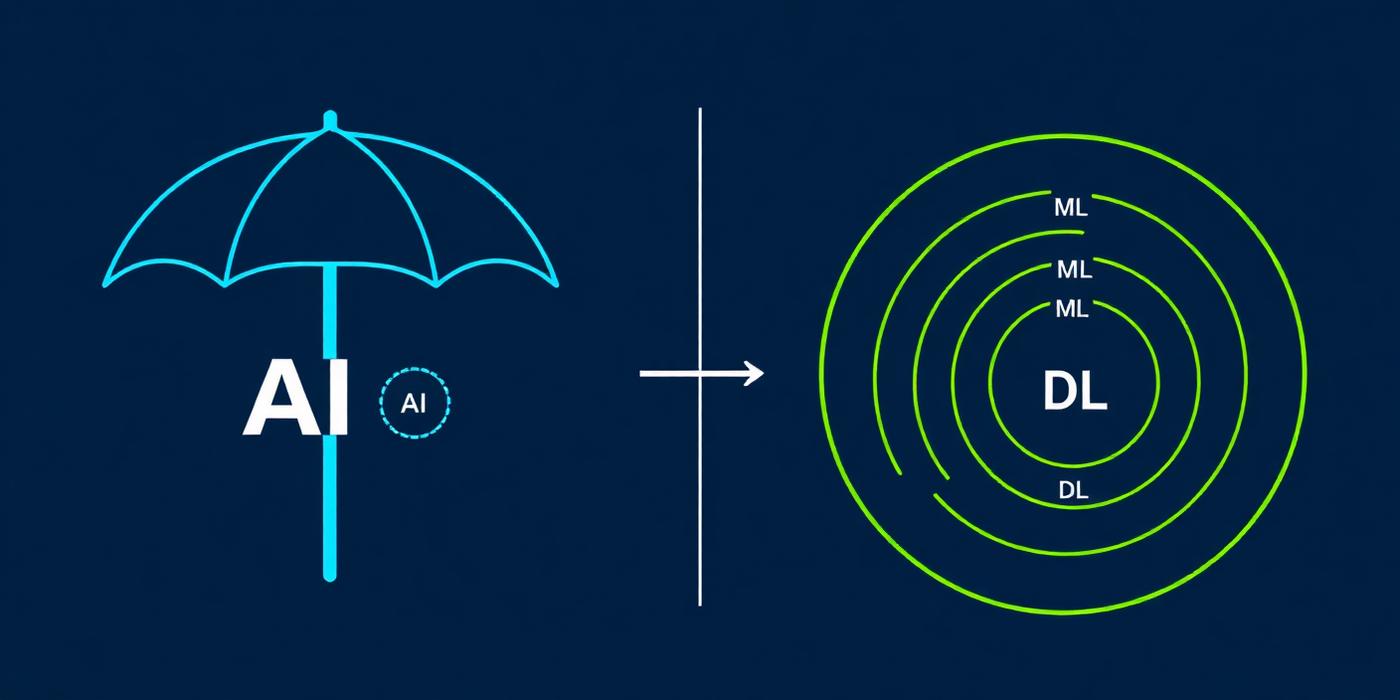
Info Card — The Nesting: All Machine Learning is AI. All Deep Learning is Machine Learning. But not all AI is ML (rule-based expert systems are AI but not ML), and not all ML is Deep Learning.
6. Deep Learning Explained

Deep Learning is ML using neural networks with many layers — inspired loosely by the human brain. Each layer transforms the input a little, and by stacking dozens or hundreds of layers, the network learns extremely complex patterns.
Deep Learning is what powers:
- Computer Vision — face recognition, medical imaging, self-driving cars.
- Speech Recognition — Siri, Alexa, Google Voice.
- Natural Language Processing — translation, sentiment analysis, chatbots.
- Generative AI — image, video, and text generation.
The breakthrough came in 2012 when a deep neural network called AlexNet crushed the ImageNet competition. Combined with GPUs (originally built for gaming) and big data, Deep Learning became the dominant AI paradigm.
7. Generative AI
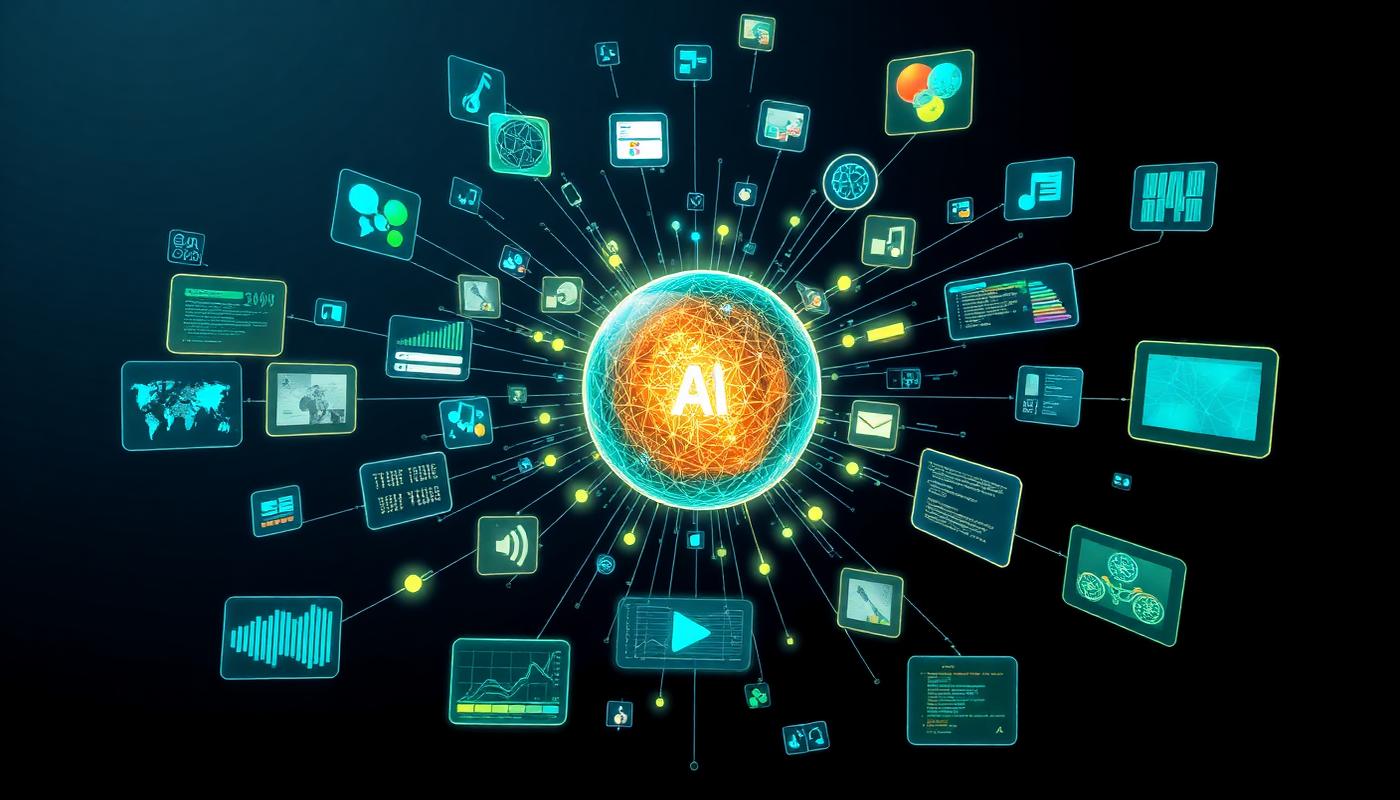
Generative AI is the branch that creates new content — text, images, code, audio, video — instead of just analyzing existing content. It's what most people mean today when they say "AI."
Popular generative systems include:
- Text: ChatGPT (OpenAI), Claude (Anthropic), Gemini (Google), Llama (Meta).
- Images: Midjourney, DALL·E, Stable Diffusion, Flux.
- Video: Sora, Runway, Veo.
- Code: GitHub Copilot, Cursor, Claude Code.
- Audio & Music: ElevenLabs, Suno, Udio.
Generative AI is powered by two families of models: Diffusion Models (great for images/video) and Transformer-based Large Language Models (great for text and code).
8. Large Language Models (LLMs)
An LLM is a neural network trained on trillions of words from the internet, books, and code. It learns statistical relationships between tokens (roughly, word fragments) so well that it can generate coherent text on almost any topic.
Under the hood, every modern LLM uses the Transformer architecture introduced by Google in the 2017 paper "Attention Is All You Need."
Why LLMs matter for your career:
- They are the fastest path from "beginner in AI" to "shipping AI-powered products."
- Prompt Engineering is a real, well-paid skill.
- Retrieval-Augmented Generation (RAG), agents, and tool-use are the next wave — and they're accessible to any developer.
9. Real-World Applications
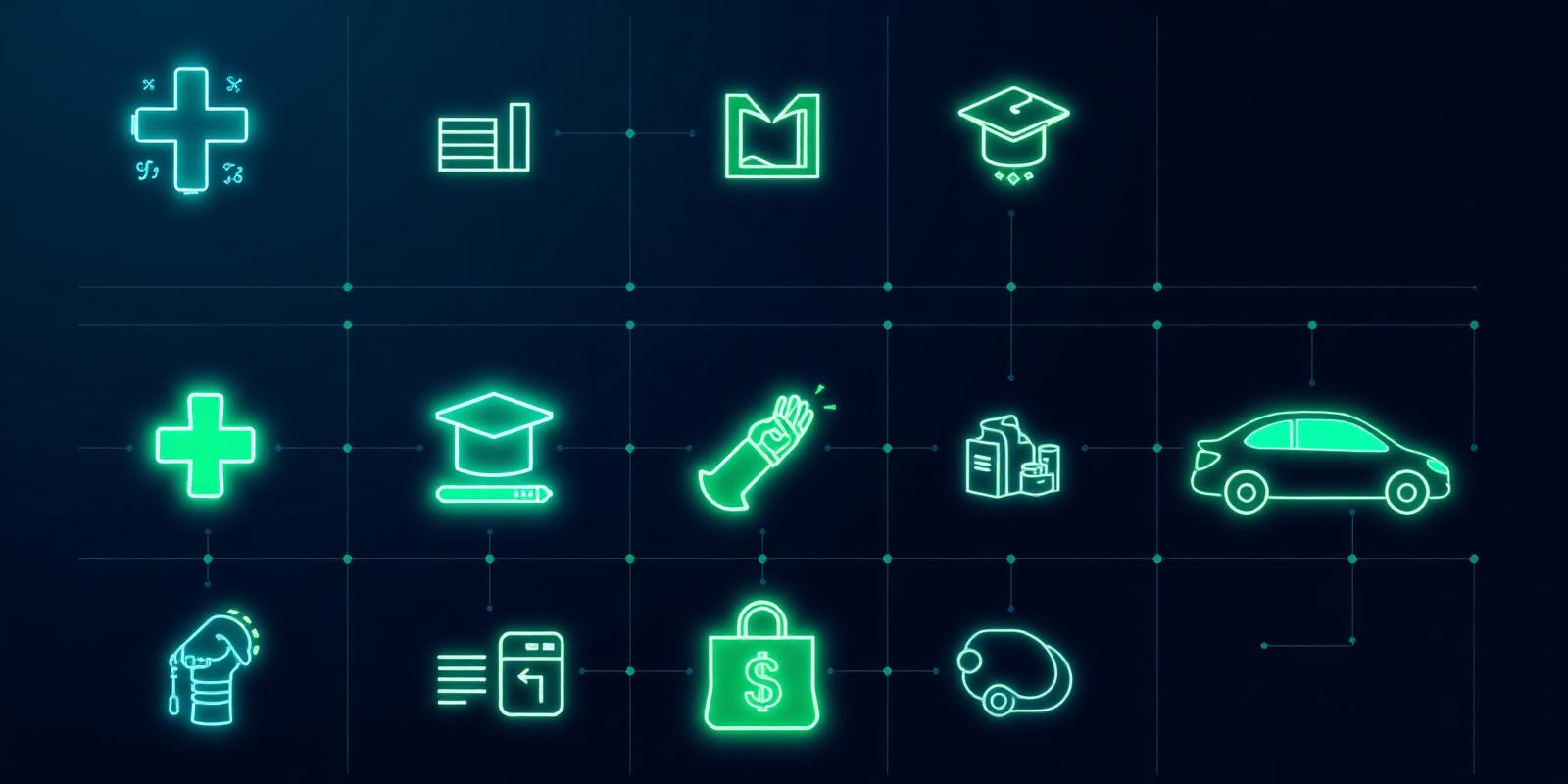
AI is not a future technology. It's an already-shipping technology across every major industry.
| Industry | What AI Does |
|---|---|
| Healthcare | Diagnose disease, discover drugs, personalize treatment |
| Finance | Detect fraud, price risk, automate trading |
| Retail | Recommend products, forecast demand, personalize search |
| Manufacturing | Predictive maintenance, robotic assembly, quality control |
| Transportation | Autonomous driving, route optimization, ride-share matching |
| Education | Adaptive learning, tutoring, grading assistance |
| Media | Content generation, personalization, moderation |
| Cybersecurity | Anomaly detection, phishing prevention, threat hunting |
Let's zoom into four of the biggest.
10. AI in Healthcare

Healthcare is one of AI's highest-impact frontiers. Real, deployed use cases include:
- Medical Imaging — AI models detect cancers in X-rays, CTs, and MRIs with accuracy rivaling specialists.
- Drug Discovery — DeepMind's AlphaFold has predicted the structure of virtually every known protein, cutting years off drug research timelines.
- Personalized Medicine — ML models tailor treatment plans to individual genetic profiles.
- Clinical Documentation — LLM-based scribes automatically write patient notes, giving doctors back hours per day.
Stat: According to Nature Medicine, AI-assisted radiology can reduce missed diagnoses by up to 30% in some cancers.
11. AI in Finance

Banks and fintechs have used ML for decades — long before "AI" was cool. Today's use cases include:
- Fraud Detection — real-time scoring of every transaction.
- Credit Scoring — beyond traditional bureaus, using alternative data.
- Algorithmic Trading — quant firms run thousands of ML models across markets.
- Robo-Advisors — automated portfolio management for retail investors.
- AI Copilots — Bloomberg GPT, JPMorgan's IndexGPT, and internal LLM assistants for analysts.
12. AI in Education

Education is being reshaped fastest — and this is exactly the space Glintr operates in.
- Adaptive Learning Paths — content adjusts to each learner's pace.
- AI Tutors — 24/7 explanation of any concept.
- Automated Grading — instant, detailed feedback on essays and code.
- Content Generation — teachers create quizzes, examples, and lesson plans in seconds.
- Career Guidance — AI mentors trained on real industry data.
At Glintr, our AI Mentor, AI Content Factory, and Voice AI Learning platform show what's possible when AI is built natively into an EdTech product from day one.
13. AI in Manufacturing
- Predictive Maintenance — sensors + ML predict machine failure days in advance.
- Robotic Assembly — vision-guided robots handle complex parts.
- Quality Inspection — computer vision catches defects at line speed.
- Supply Chain Optimization — forecasting demand across thousands of SKUs.
Factories powered by AI ("smart factories") are the backbone of Industry 4.0.
14. AI Career Opportunities

The demand for AI talent is unlike anything the tech industry has seen. Roles you can target:
| Role | What They Do | Typical Salary Band (India) |
|---|---|---|
| AI Engineer | Build production AI systems end-to-end | ₹12–40 LPA |
| Machine Learning Engineer | Design, train, and deploy ML models | ₹10–35 LPA |
| Data Scientist | Extract insights and build predictive models | ₹8–30 LPA |
| Prompt Engineer / LLM Engineer | Design prompts, agents, and RAG systems | ₹10–35 LPA |
| AI Product Manager | Own AI-powered product roadmaps | ₹15–45 LPA |
| MLOps Engineer | Deploy, monitor, and scale ML in production | ₹12–35 LPA |
| AI Researcher | Publish and push the frontier | ₹20 LPA – ₹1 Cr+ |
| AI Solutions Consultant | Help enterprises adopt AI | ₹15–40 LPA |
Salaries in the US, UK, and Middle East are typically 2–4× higher for equivalent roles.
15. Required Skills
You don't need to master everything. You need the right core stack:
Foundational
- Python programming
- Mathematics: linear algebra, probability, calculus (intuition, not proofs)
- Data manipulation with Pandas and NumPy
Core ML/DL
- Scikit-learn for classical ML
- PyTorch (or TensorFlow) for deep learning
- Model evaluation, feature engineering, hyperparameter tuning
Modern AI
- Prompt engineering and prompt design patterns
- LLM APIs (OpenAI, Anthropic, Google, open-source)
- RAG (Retrieval-Augmented Generation) and vector databases
- AI agents and tool-use
Production
- Git, Docker, REST APIs
- Cloud (AWS, GCP, or Azure) fundamentals
- MLOps basics (model deployment, monitoring)
Soft Skills
- Communication (explain models to non-technical stakeholders)
- Product thinking (know why the model matters)
- Curiosity and rapid learning (the field changes monthly)
16. Learning Roadmap
Here's a realistic 6–12 month roadmap from zero to your first AI role:
Months 1–2 — Programming Foundations
- Python fundamentals
- NumPy, Pandas, Matplotlib
- Git, GitHub, VS Code
Months 3–4 — Machine Learning
- Supervised & unsupervised learning
- Scikit-learn
- 2–3 end-to-end projects (regression, classification, clustering)
Months 5–6 — Deep Learning
- Neural networks fundamentals
- PyTorch
- Computer vision or NLP project
Months 7–8 — LLMs & Generative AI
- Prompt engineering
- Building with the OpenAI / Anthropic / Gemini APIs
- RAG project with a vector database
- Fine-tuning basics
Months 9–10 — Production & Portfolio
- FastAPI + Docker
- Deploy 2 real AI apps
- Contribute to an open-source repo
Months 11–12 — Interviews & Landing the Role
- LeetCode + ML system design
- Case studies
- Applications, referrals, and mock interviews
Callout — The single biggest mistake beginners make: collecting courses instead of shipping projects. Ship at every stage. Recruiters hire portfolios, not certificates.
17. The Future of AI

Where is AI heading between 2026 and 2030?
- Agentic AI — AI that plans, uses tools, and executes multi-step tasks autonomously.
- Multimodal Everything — models that seamlessly handle text, image, audio, video, and 3D.
- On-Device AI — models running privately on your phone or laptop.
- AI + Robotics — physical AI in warehouses, homes, hospitals, and vehicles.
- AI in Science — accelerated discovery in biology, chemistry, materials, and climate.
- Regulation & Governance — the EU AI Act, US frameworks, and India's DPDP shape how AI is built and shipped.
- AI Literacy as a Baseline Skill — like Excel in the 2000s, AI fluency becomes non-negotiable in every white-collar role.
The professionals who thrive won't be the ones who fear AI or blindly worship it. They'll be the ones who use it as leverage — to build, learn, and earn faster than any generation before them.
18. Frequently Asked Questions
1. Do I need to know advanced math to work in AI? No. You need intuition around linear algebra, probability, and calculus — not proofs. Modern libraries handle the heavy lifting. Math becomes essential only if you're going deep into research.
2. Will AI take my job? AI won't replace most jobs — but people who use AI will replace people who don't. Focus on becoming an AI-augmented professional in your field.
3. Is AI hard to learn as a beginner? It's very learnable in 2026. Tools like ChatGPT, Claude, and Cursor make the learning curve dramatically shorter than it was even 3 years ago.
4. What's the difference between AI, ML, and Deep Learning? AI is the broad field. ML is a subset of AI that learns from data. Deep Learning is a subset of ML that uses multi-layer neural networks.
5. Which programming language should I learn first? Python. It's the standard for AI/ML, has the richest ecosystem, and is beginner-friendly.
6. How long does it take to become an AI Engineer? With focused effort, 6–12 months is enough to become job-ready for an entry-level AI role — especially if you build a strong project portfolio.
7. Do I need a computer science degree? No. Many top AI practitioners are self-taught or come from adjacent fields (physics, math, economics, design). Skills and portfolio matter more than degree.
8. What's Generative AI and why is everyone talking about it? Generative AI creates new content — text, images, code, video. ChatGPT is its most famous example. It's changing how we work, write, design, and build software.
9. What are LLMs? Large Language Models are neural networks trained on massive text datasets that can understand and generate human-like text. ChatGPT, Claude, and Gemini are all LLMs.
10. Where should I start today? Pick one structured path (like Glintr's AI Career Track), commit 1–2 hours a day, and ship your first small project within 30 days. Momentum matters more than perfection.
19. Final Summary
Artificial Intelligence is the defining technology of this decade. It's not a fad, it's not magic, and it's not out of reach. It's a stack of learnable skills — Python, ML, Deep Learning, LLMs, and production engineering — sitting on top of decades of research and a global explosion of demand.
If you're a student, this is the field to bet your career on. If you're a working professional, this is the leverage that will 10× your impact. If you're a career switcher, there has never been a better window — the tools are more accessible, the roadmap is clearer, and the market is hungrier than at any point in history.
The only real question is: when do you start?